
 Sylvia Melena
Employees disengage when their strengths are not honored at work.
When this happens, they’re less motivated, contribute less, and are more likely to underperform.
This isn’t a lack of talent. It’s a lack of employee development to people’s desired potential.
The DISC Model provides a practical assessment framework for understanding the natural behavioral strengths people bring to work every day. Used correctly, it can help leaders delegate work and develop employees much more effectively.
This blog focuses on how leaders can leverage people’s DISC strengths in the workplace. For practical information on how to implement a DISC rollout, read Using DISC in the Workplace: A Practical Implementation Guide.
- Why DISC Strengths Matter
- The Strengths of the Four DISC Styles
- A Snapshot of DISC Styles Strengths
- A Deeper Look at the Strengths of the Four DISC Styles
- Leveraging DISC Strengths in the Workplace
- Aligning Work to People’s DISC Strengths
- The Bottom Line
- DISC Facilitation Resources
- Who’s Behind LeadershipStrength.com?
Why DISC Strengths Matter
Employees perform at their best when they have opportunities to use their natural strengths. Yet many managers unknowingly assign work, coach performance, and recognize employees in ways that don’t align with how people naturally contribute. Over time, that disconnect can reduce engagement, confidence, and performance.
The DISC Model helps leaders better understand the behavioral strengths employees bring to the workplace. Rather than focusing on what people are doing wrong, DISC highlights how they naturally approach challenges, communicate with others, solve problems, and contribute to team success.
Understanding these strengths helps managers better delegate work, develop employees, and balance the DISC strengths of their teams. This translates to better organizational results.
The Strengths of the Four DISC Styles
Every DISC style brings a different set of behavioral strengths to the workplace. Some employees naturally drive results. Others build relationships, create stability, or improve quality. None of these strengths is inherently better than another. They simply contribute in different ways.
As you read through the four styles, remember that no one fits perfectly into a single category. Most people demonstrate characteristics of more than one DISC style, with one or two styles typically influencing their behavior more strongly than the others.
The strengths below represent common behavioral tendencies associated with each style. They’re a starting point for understanding employees, not labels or assumptions about what they can or cannot do.
A Snapshot of DISC Styles Strengths
Before exploring each DISC style in more detail, here’s a quick overview of the strengths each style commonly brings to the workplace.
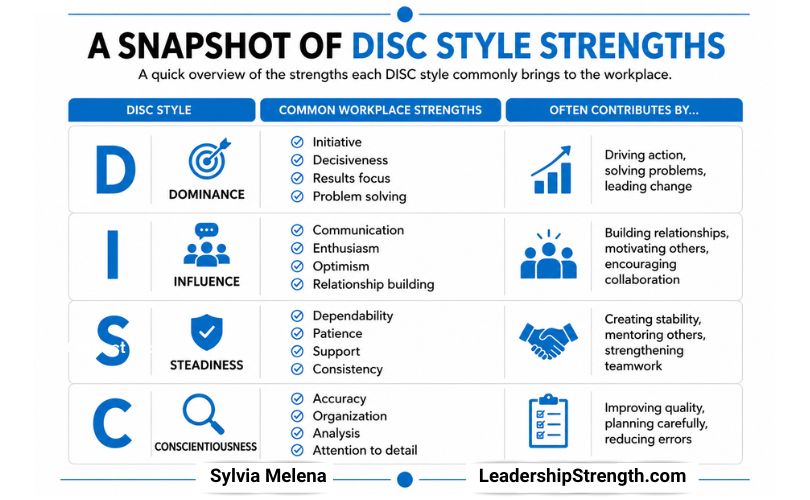
| DISC Style | Common Workplace Strengths | Often Contributes By… |
| Dominance (D) | • Initiative • Decisiveness • Results focus • Problem solving | Driving action, solving problems, and leading change. |
| Influence (I) | • Communication • Enthusiasm • Optimism • Relationship building | Building relationships, motivating others, and encouraging collaboration. |
| Steadiness (S) | • Dependability • Patience • Support • Consistency | Creating stability, mentoring others, and strengthening teamwork. |
| Conscientiousness (C) | • Accuracy • Organization • Analysis • Attention to detail | Improving quality, planning carefully, and reducing errors. |
While each DISC style brings different strengths, high-performing teams require the contributions of all four. Applied correctly, the DISC Model actually improves team communication.
A Deeper Look at the Strengths of the Four DISC Styles
Dominance (D) Style Strengths
People with a high Dominance (D) style tend to focus on results, challenges, and accomplishing goals. They often enjoy taking initiative, solving difficult problems, and moving projects forward. In fast-paced environments, they frequently become the people others look to when decisive action is needed.
Common Dominance (D) Strengths
- High D employees often demonstrate strengths such as:
- Making decisions confidently
- Taking initiative without waiting to be asked
- Solving problems quickly
- Remaining focused on results
- Challenging inefficient processes
- Working well under pressure
- Delegating responsibilities effectively
- Maintaining momentum toward goals
These strengths often make high D employees valuable during periods growth or organizational change, when things need to get done.
How Dominance (D) Strengths Show Up at Work
Imagine a project that’s suddenly falling behind schedule after unexpected setbacks. While the rest of the team debates possible solutions, a high D project leader quickly evaluates the situation, identifies the biggest obstacles, assigns responsibilities, and establishes a new timeline.
Not every decision is perfect, but progress resumes because someone was willing to take immediate action.
This ability to move people toward solutions is one of the defining strengths of the Dominance style.
Ideas for Engaging High D People
- Give them ownership of meaningful projects.
- Clarify and define desired outcomes and non-negotiables, while allowing flexibility in how the work gets done.
- Involve them in solving complex problems.
- Provide opportunities to lead initiatives or process improvements.
- Offer direct, concise feedback.
- Challenge them with assignments that require initiative and decision-making.
While many high D team members enjoy taking charge, don’t assume every person with this style wants to lead a project. Take time to understand each individual’s interests, priorities, and desires before providing development opportunities.
Influence (I) Style Strengths
People with a high Influence (I) style often bring enthusiasm, optimism, and energy to the workplace. They naturally enjoy connecting with others, building relationships, and encouraging collaboration. Their ability to communicate and inspire can positively influence team morale and employee engagement.
Common Influence (I) Strengths
- Building strong relationships
- Communicating with enthusiasm
- Encouraging collaboration
- Motivating others
- Persuading and influencing
- Generating creative ideas
- Creating a positive work environment
- Helping others feel included
- Networking across departments and stakeholders
- Inspiring team participation
These strengths often make high I employees effective communicators, facilitators, mentors, and change champions.
How Influence (I) Strengths Show Up at Work
A company introduces a new technology that many employees are hesitant to adopt. While others focus on explaining the technical details, a high I team member spends time encouraging coworkers, answering questions, sharing success stories, and helping people feel more confident about the transition.
Their enthusiasm doesn’t replace technical conversation, but it helps build the buy-in needed for successful implementation.
Ideas for Engaging High I People
- Provide opportunities for collaboration.
- Include them in presentations or employee orientations.
- Ask them to help communicate organizational changes.
- Encourage brainstorming and idea-generation sessions.
- Recognize their achievements.
- Assign them projects that involve relationship-building, cross-functional teamwork, or stakeholder engagement.
Although many high I leaders and team members enjoy interacting with others, individual preferences still matter. Some may enjoy presenting to large groups, while others prefer one-on-one or building relationship building.
Steadiness (S) Style Strengths
People with a high Steadiness (S) style often provide consistency, dependability, and support. They tend to value cooperation, patience, and strong working relationships. Their steady approach can help teams feel valued during periods of change or uncertainty.
Common Steadiness (S) Strengths
- Being dependable and reliable
- Supporting coworkers
- Listening patiently
- Building trust
- Remaining calm under pressure
- Creating stability within teams
- Working cooperatively
- Demonstrating loyalty
- Maintaining constituency
These strengths help create an environment where people feel supported, respected, and able to do their best work.
How Steadiness (S) Strengths Show Up at Work
A new employee joins the department during one of the busiest times of the year. With everyone focused on deadlines, it’s easy for onboarding to become rushed. A high S employee naturally checks in with the new team members, answers questions, explains procedures, and offers encouragement as they learn their new responsibilities.
Their willingness to provide consistent support helps new poeple become productive more quickly while creating a positive onboarding experience.
Ideas for Engaging High S People
- Assign them responsibilities that require consistency and a steady pace.
- Involve them in mentoring new employees.
- Provide opportunities to build long-term working relationships.
- Give them time to process information before implementing significant changes.
- Recognize their reliability and contributions to the team.
- Create a safe environment where they feel comfortable sharing their ideas.
While many high S leaders and team members value stability, don’t assume they resist change. When they understand the purpose behind the transition and have time to prepare, they can be valuable partners in helping others successfully navigate the transition.
Conscientiousness (C) Style Strengths
People with a high Conscientiousness (C) style often bring accuracy, careful analysis, and attention to detail. They enjoy understanding complex problems, organizing information, and producing high-quality results. Their thoughtful approach can help organizations reduce errors, improve processes, and make well-informed decisions.
Common Conscientiousness (C) Strengths
- Analyzing information thoroughly
- Paying close attention to detail
- Producing accurate work
- Organizing complex information
- Planning carefully
- Solving problems logically
- Improving quality
- Following established processes
- Asking thoughtful questions
- Maintaining high standards
These strengths often make high C employees valuable in roles requiring careful planning, quality control, research, compliance, financial analysis, or process improvement.
How Conscientiousness (C) Strengths Show Up at Work
A department is preparing to launch a new service. Before implementation, a high C person carefully reviews procedures, verifies documentation, identifies inconsistencies, and recommends several improvements that prevent costly mistakes after launch.
This attention to detail may not receive the same visibility as a successful presentation or major sales win, but it helps protect the organization’s quality, reputation, and long-term success.
Ideas for Engaging High C People
- Provide clear expectations and objectives.
- Allowing adequate time for analysis when feasible.
- Involving them in quality improvement initiatives.
- Asking for their recommendations before making important decisions.
- Assigning projects that require careful planning or evaluation.
- Acknowledge the value they bring through accuracy and thoughtful analysis.
Although many high C employees enjoy detailed work, avoid assuming they always prefer working independently or behind the scenes. Individual interests, experience, and career aspirations should inform development opportunities.
Leveraging DISC Strengths in the Workplace
Understanding DISC strengths is only the beginning. The real value comes from applying that knowledge to help employees perform at their best.
Effective leaders don’t use DISC to label people or limit opportunities. They use it to better understand how employees naturally approach their work so they can coach more effectively, delegate strategically, and build balanced, high-performing teams.
Here are two practical ways to put DISC into action.
Observe Behavioral Patterns
Pay attention to how employees naturally approach their work. Observe how they solve problems, communicate with others, respond to challenges, and contribute to team success. Over time, these behavioral patterns provide valuable insights into the strengths they naturally bring to the workplace.
Aligning Work to People’s DISC Strengths
Not every assignment can be customized, but whenever possible, give employees the flexibility to approach their work in ways that align with their natural behavioral strengths. Clarify the desired outcome, then allow people to leverage the strengths they naturally bring to the task.
Imagine that a senior leader launches a major organizational change initiative. Four department leaders are each responsible for leading the change within their own span of control. Their shared objective is the same: successfully implement the organizational change while maintaining employee engagement. Although the vision is shared, each leader naturally approaches its implementation differently.
| DISC Style | Natural Approach to Leading Change |
| Dominance (D) | Focuses on setting a clear direction, making timely decisions, removing obstacles, and maintaining momentum so the initiative stays on track. |
| Influence (I) | Builds enthusiasm for the change by communicating the vision, generating buy-in, addressing concerns openly, and keeping people engaged throughout the process. |
| Steadiness (S) | Creates stability during uncertainty by listening carefully, providing reassurance, supporting employees through the transition, and encouraging collaboration. |
| Conscientiousness (C) | Develops detailed implementation plans, anticipates potential risks, establishes processes, and ensures the change is executed accurately and effectively. |
The outcome is the same: a successful change initiative. The difference lies in how each leader naturally approaches the work. Recognizing these differences helps managers leverage employees’ strengths while ensuring important perspectives are represented throughout the process. High-performing teams don’t need everyone to approach work the same way. They benefit from different approaches.
The Bottom Line
Every employee brings strengths that can contribute to organizational success. The most effective leaders recognize those strengths, create opportunities for employees to use them, and build teams where different approaches are valued.
DISC doesn’t tell leaders what employees can or cannot do. Instead, it provides a practical framework for understanding how people naturally communicate, solve problems, collaborate, and contribute. When leaders understand those differences, they can better delegate work, develop talent, improve collaboration, and help employees perform at their best.
High-performing organizations don’t succeed because everyone works the same way. They succeed because leaders know how to leverage the unique strengths each person brings to the team.
DISC Facilitation Resources
Who’s Behind LeadershipStrength.com?
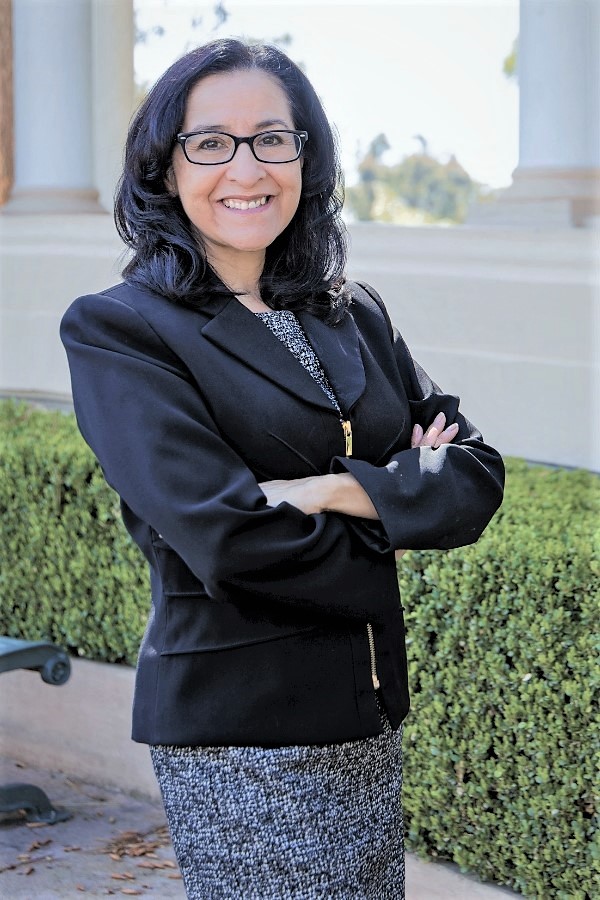
SYLVIA MELENA is the Principal of Melena Consulting Group, a leadership and organizational development company. She is also the international award-winning and best-selling author of Supportive Accountability: How to Inspire People and Improve Performance and the creator of the Supportive Accountability Leadership™ Model.