 Sylvia Melena
Picture this: a manager sends a two-sentence email about a project change. No greeting, no context, just the update and a deadline.
One teammate reads it and thinks, “Great, efficient.”
Another wonders if they’re in trouble.
A third feels blindsided, says nothing, and starts to disengage.
Nobody is being unreasonable. They’re just wired differently, and nobody has ever named it aloud.
This article delves into:
- What each DISC style actually sounds like in conversation,
- Where friction typically starts,
- How managers can adapt their approach, and
- Three exercises leaders and facilitators can use with workplace teams.
- How Does the DISC Model Improve Team Communication?
- What Each DISC Style Sounds Like in a Conversation
- Where Team Communication Breaks Down
- How Do You Leverage the DISC Model to Improve Team Communication? Start with Manager Adaptations
- Adapting Feedback Delivery to the Four DISC Styles
- Running Meetings That Work for all Four DISC Styles
- Communicating Decisions Across the DISC Style Spectrum
- Three DISC Team Activities That Put DISC Insights Into Practice
- Why a Structured DISC Team Session is the Right Starting Point
- What a Facilitated Team DISC Session Includes
- How the Melena Consulting Group Makes DISC Team Sessions Accessible
- A Quick Checklist Before Your First DISC Team Session
- The Bottom Line
How Does the DISC Model Improve Team Communication?
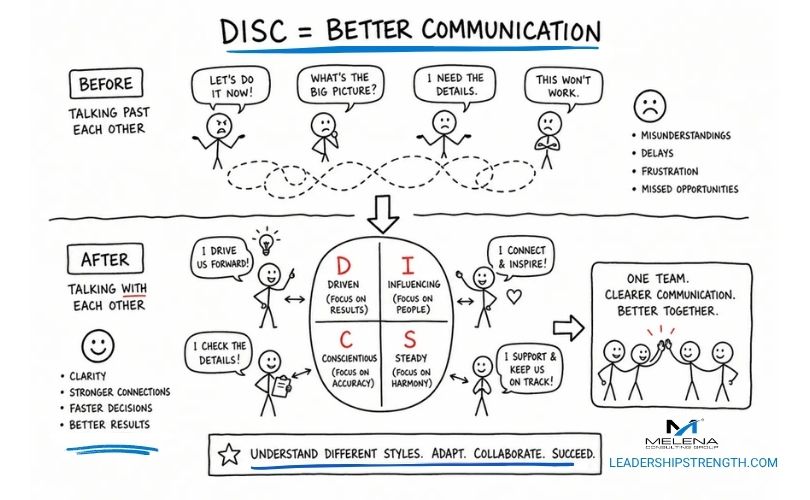
DISC gives teams a shared language for those exact differences, not a set of personality labels to stereotype each other, but a practical framework for understanding how people prefer to send and receive information, process decisions, and engage under pressure.
The four styles, Dominance, Influence, Steadiness, and Conscientiousness, describe behavioral tendencies that show up in every meeting, email, and feedback conversation.
When teams understand these patterns, they stop reading intent into behavior and start responding to actual needs.
Melena Consulting Group has applied this framework across various workplace settings, consistently finding that naming communication differences is one of the most accessible first steps toward shifting a team’s culture.
What Each DISC Style Sounds Like in a Conversation
Understanding the four styles isn’t about memorizing personality types. It’s about recognizing the communication signals people send every day and knowing how to respond to them effectively.
For a solid but brief overview of all four styles, read The Four DISC Styles of Leadership Communication.
D (Dominance): Get to the Point or Lose Them
D-style communicators are direct, fast, and results-focused. They want the bottom line first, options second, and small talk never.
In a meeting, a D-style team member is the one asking, “What’s the decision and who owns it?” They’re not being rude. They’re operating from a results-first mental model where process details feel like obstacles. Their biggest trigger is being over-explained to. Spend three minutes on context before getting to the ask, and you’ve lost them.
I (Influence): Give Them Stories, Energy, and Connection First
I-style communicators are expressive, enthusiastic, and people-first. They build rapport before getting to business and process information through storytelling and group energy.
You’ll hear an I-style say, “Before we jump into the numbers, can we talk about what went well?” That’s not stalling. That’s their natural communication sequence. Their triggers are being cut off, ignored, or forced into a rigid, data-only format. Strip the human element from a conversation with an I-style communicator, and you lose their engagement entirely.
S (Steadiness): Slow It Down and Keep It Safe
S-style communicators prefer calm, consistent, and low-pressure interactions. They build trust slowly and don’t respond well to sudden changes or being put on the spot.
In a meeting, the S-style team member might say, “Can I take some time to think that over before we decide?” That’s not resistance. That’s their trust-building process at work. Their triggers are abrupt decisions and unaddressed team tension. Push them too fast, and they go quiet, which managers often misread as agreement when it’s actually discomfort.
C (Conscientiousness): Provide Facts First and Feelings Second
C-style communicators are precise, analytical, and detail-oriented. They prefer written communication, want to verify information before committing, and interpret vague statements as unreliable.
A C-style team member in a planning session will say, “I’d like to review the data before we finalize the approach.” That’s not obstruction. That’s quality control in human form. Their trigger is being rushed and presented with incomplete information. Ask a C-style to decide without sufficient evidence, and you’ll get silence or reluctant compliance, neither of which serves the team.
Where Team Communication Breaks Down
Knowing the four DISC styles is useful. But understanding why specific style combinations create friction is what transforms team behavior.
The Speed vs. Accuracy Clash (D vs. C)
A D-style manager wants a fast decision. The C-style team member needs three more days to verify the data.
Neither one is being difficult. They’re both operating from completely different definitions of “ready.”
This D vs. C dynamic is a frequent source of friction in meetings, and it reads as stubbornness from both sides when neither party understands what’s driving the other. Left unaddressed, it can stall decisions and breed resentment that compounds over time.
The Enthusiasm vs. Caution Clash (I vs. S)
An I-style colleague pitches a bold new idea with contagious energy. The S-style team member stays quiet, processes internally, and gets labeled as “not a team player” or “resistant to change.”
In reality, the S-style needs time and safety to engage, not a performance stage.
Recognize this pattern, and the solution becomes clear: slow the room down and create space for the quieter voice before calling for alignment. A single facilitation move, giving the S-style an explicit invitation to share after some processing time, can help prevent prolonged cycles of misread dynamics.
How Do You Leverage the DISC Model to Improve Team Communication? Start with Manager Adaptations
Adapting your communication style isn’t about being inauthentic.
It’s about closing the gap between what they intend to say and what the other person actually hears. For a deeper look at how these dynamics specifically affect leaders, see How DISC Styles Influence Leadership Communication (and Why It Matters).
Adapting Feedback Delivery to the Four DISC Styles
The same feedback lands completely differently depending on how it’s framed.
For D-style Team Members
Lead with business impact and skip the preamble. “This approach is costing us time on delivery” lands better than a five-minute warm-up.
For I-style Team Members
Open with recognition and connect improvement to a bigger vision: “Your energy on this project is a real asset. Here’s how we can channel it even more effectively.”
For S-style Team Members
Frame feedback as support rather than judgment. Move slowly and offer a step-by-step plan so they don’t feel thrown into the deep end.
For C-style Team Members
Use data, share feedback in writing when possible, and give them time to process before expecting a response.
Running Meetings That Work for all Four DISC Styles
When adapting your approach to team meetings, the goal is not to over-cater to every preference but to structure meetings so no style is consistently sidelined.
State the agenda and the decision goal up front. This serves the D-style who needs to know why they’re in the room.
Open with a brief connection moment before diving in, which keeps the I-style engaged from the start.
Share materials in advance when possible so the S- and C-styles arrive prepared instead of feeling caught off guard.
Close every meeting with clear next steps and owners, which gives both D and C the closure and accountability they need to feel productive.
Communicating Decisions Across the DISC Style Spectrum
When sharing an executive decision with your team, the sequencing of information matters more than most managers realize.
D-style team members need the outcome first.
C-style team members need the reasoning and evidence.
S-style team members need the transition plan and reassurance about what stays the same.
I-style team members need the vision and the collaborative framing.
This simple template covers all four priorities:
- State the decision
- Explain the reasoning
- Describe the transition
- Then frame the bigger picture
Practiced and delivered concisely, that sequence addresses every style’s core communication need in one pass.
And of course, facilitate free expression of questions, concerns, and recommendations. People need to be heard.
Three DISC Team Activities That Put DISC Insights Into Practice
Reading about the styles is useful.
But experiencing them in a team context is where real shifts happen.
These three DISC activities are reproducible, time-stamped, and built for real work environments. If you’d like additional context on the four communication styles before running exercises, grab your free copy of the Quick Guide to DISC Leadership Styles.
Activity 1: Walk a Mile in My Profile (30 – 40 minutes)
Pair team members with opposing DISC profiles and give them a copy of the DISC assessment report and a realistic conflict scenario, a missed deadline, a disagreement on project priorities, or a client complaint.
Each person role-plays from their partner’s behavioral style: a D-style acts like a C, an I-style acts like an S. After some dialogue, the group reflects on what they noticed.
This exercise tends to build empathy quickly because people physically experience the perspective shift rather than just reading about it.
Useful debrief questions: “How did it feel to act from your partner’s perspective?” and “What behaviors revealed which style you were playing?”
Activity 2: Speed DISC Sharing (20 – 30 minutes)
Pair team members with contrasting styles and give them a brief moment to share their DISC Style, their preferred communication approach, and one strength they bring to the team. Rotate pairs so every member connects with three to five colleagues, then close with a group discussion.
This works especially well before a major project kickoff or after a period of team tension. It resets communication expectations in a low-stakes format that doesn’t require anyone to be vulnerable in front of the whole room.
Activity 3: DISC Strengths Mapping (25 – 35 minutes)
Create a large four quadrant DISC styles chart and add every team member’s style onto it. Identify where the team is clustered and where gaps exist. Based on the description in the DISC Assessment, discuss the implications for the team.
This exercise can surface how a team collaborates and approaches team goals in a tangible way.
Close the activity by having each person commit to one specific change in how they’ll approach collaboration or team goals based on what the DISC Strengths Mapping exercise revealed.
Why a Structured DISC Team Session is the Right Starting Point
Self-study gets teams thinking.
A structured session gets teams changing.
The difference is in the debrief, the conversation that turns individual data into shared commitments.
What a Facilitated Team DISC Session Includes
A properly facilitated DISC team session includes individual profiles, a team composite report, and facilitated debrief conversations that translate data into action.
The team composite report shows your group’s collective style distribution, communication patterns, and potential blind spots as a unit rather than as a collection of individuals.
Without the debrief, most teams read their reports, find them interesting, and move on without changing anything. The conversation is where the insight becomes action.
If you want a practical walkthrough on identifying individual patterns before the session, review How to Identify the DISC Styles for a step-by-step approach.
How the Melena Consulting Group Makes DISC Team Sessions Accessible
Melena Consulting Group offers a brandable DISC assessment platform through the DISC Facilitator Hub, built for HR professionals, internal trainers, and independent consultants who want to run team DISC sessions without promoting a third-party brand. The platform includes robust team-level reporting and workshop-ready facilitation materials.
For organizations running internal sessions or consultants delivering DISC workshops for clients, the DISC Facilitator Kit provides a structured approach to delivering a focused, credible session.
A Quick Checklist Before Your First DISC Team Session
- Confirm all team members have completed their individual assessments before the session date.
- Review the team composite report in advance to identify style clusters and gaps
- Select one or two of the exercises above to run during the debrief
- Prepare two to three open-ended questions that guide discussion without steering it toward a predetermined outcome
The Bottom Line
Teams rarely struggle because people are difficult.
More often, different behavioral styles create communication patterns that feel personal but are entirely predictable once you have a framework to interpret them.
A two-sentence email isn’t dismissive.
A slow decision isn’t obstruction.
Staying quiet in a meeting isn’t disengagement.
These are behavioral styles operating without a shared language to make sense of them.
That’s precisely how the DISC Model improves team communication: it gives managers a framework to name the patterns, adapt their delivery, and create conditions where every style can contribute clearly.
Start by understanding your team’s style composition. Then adjust how you deliver feedback and structure meetings. From there, run at least one exercise that makes the differences visible and discussable. Each of these steps produces improvements in understanding and communication that teams can feel within a single session, and compound over time as the shared language becomes second nature.
If you’re ready to move from awareness to real change, visit Melena Consulting Group’s DISC Facilitator Hub, a continuum of DISC assessment, coaching, and training resources, from a free quick guide to a robust, fully brandable DISC assessment platform to scale your internal or client team development.
Who Heads Melena Consulting Group?

SYLVIA MELENA is the Principal of Melena Consulting Group, a leadership and organizational development company. She is also the international award-winning and best-selling author of Supportive Accountability: How to Inspire People and Improve Performance and the creator of the Supportive Accountability Leadership™ Model.